Wednesday, June 5, 2013

Letter to an Upcoming Math Analysis Student

This may sound repetitive hearing it all of the time, but never procrastinate in this class! Work ethic is extremely important. Always manage your time wisely so you can get your work done without being stressed out. Never put anything off (pqs, watching videos, etc.) even if you have a bunch of other homework from other classes, or you WILL be stressed out! I've been there so many times and it's the worst feeling ever. Knowing you have so much to do will become discouraging and it will cause you to not put as much effort into your work. You should always put effort into your work and make sure you understand everything that is given to you. This will allow you to have a very successful year.  Remember to be productive in class and make your time useful. You are able to have the support of Mrs. Kirch and your classmates during class and at home whenever you are stuck on a problem/concept. This flipped classroom is supposed to suit your needs. Every student learns at a different pace and this flipped classroom allows you to adjust how you are learning however you please. Playlists, student videos, and student problems that you will soon create are supposed to help you adapt to technology and use it to your advantage and allow you to learn. This flipped classroom allows you to become capable of communicating with your teacher and asking questions whenever you are stuck or confused on a concept at any time. All the resources you need are given to you. Take advantage of it! Initially, this class may sound very unappealing. You've heard of the abundant amount of work this class requires compared to your other math classes and it's probably caused you to lose confidence. All this work that is given to you is supposed to be beneficial to you, and not seen as torture. As long as you are doing all of your work completely and with integrity, there is no reason for you to be struggling in this class. Trust me, have a positive mindset throughout the rest of the school year in order to make the school year more enjoyable and in the end, you will have achieved a sense of accomplishment. 

Godspeed, Cindy T.

Monday, June 3, 2013

Unit V Biq Questions

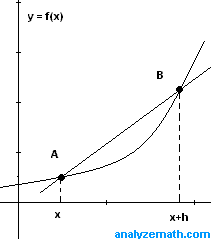
Explain in detail where the formula for the difference quotient comes from now that you know!  Include all appropriate terminology (secant line, tangent line, h/delta x, etc). 

A  represents the tangent line. B represents the secant line.


The difference quotient is the rate of change of a secant line. The formula for finding the difference quotient is: y2-y1/x2-x1.  A secant line touches the graph twice.
Difference Quotient:

We can find the derivative by using the difference quotient.
Initially, the derivative is when we evaluate the limit (lim -> 0) of the difference quotient. It helps us find the slope of the tangent line (touches the graph once) in a graph. We do this because the smaller the delta x (h/change) is, the more the secant and tangent line resemble each other. We use lim -> 0 in order to make the delta x as small possible (a function can have diff. derivatives at the value of x). :)

Work Cited:
Graph: http://www.analyzemath.com/calculus/Differentiation/difference_quotient.html
Diff. Quotient image: http://www.coastal.edu/mathcenter/HelpPages/Difference%20Quotient/img001.GIF

Monday, May 27, 2013

Unit U Big Question

1. What is continuity? What is discontinuity? 
Continuity: predictable; it has no breaks, no holes, and no jumps. It can be drawn with a single, unbroken pencil stroke and makes a good bridge (can't fall off/fall through). Discontinuity is the exact opposite (breaks, holes, jumps)..

2. What is a limit? When does a limit exist? When does a limit not exist? What is the difference between a limit and a value? 
A limit is the intended height of the function. Limits exist at removal discontinuities: point discontinuity (hole). It exists here because it is the intended height of a function. Limits do not exist at the three non-removable discontinuities: l/r behavior (jump behavior), unbounded behavior (vertical asymptotes/approaches different values from the left and the right), and oscillating behavior (wiggly/does not approach any single value). A value is the actual height of a function.

3. How do we evaluate limits numerically, graphically, and algebraically?
Numerically - We evaluate limits numerically by using a table. The table will contain the x and y values and helps us find the lim f(x) by using our graph to trace.
Graphically - Go to the 'y=' screen, plug in your f(x), press GRAPH, hit TRACE, and trace to the value you are looking for.
Algebraically - you can use the method of substitution (taking the number the limit is approaching and plugging it in anywhere you see "x"), the factoring/dividing out method when substitution gives us 0/0 and when the numerator/denominator is factorable, or rationalizing by multiplying by the conjugate.

Citations!:
Removable/nonremovable discontinuities image: www.kirchmathanalysis.blogspot.com

Wednesday, April 24, 2013

Unit T Big Question #4:

4. Why do sine and cosine NOT have asymptotes, but the other four trig graphs do? Use unit circle ratios to explain. 

Sine and cosine do not have asymptotes because of their different unit circle ratios.
Sine = y/r & cosine = x/r. R will always equal 1.

Ratio chart:
This chart displays the ratios of all the trig functions.  Because 'r' will always equal 1, there is no way that sine and cosine can ever be undefined & have asymptotes. Instead,they have amplitudes. 
However, the other trig functions do have asymptotes b/c their denominator is capable of equaling to 0 -> causing the trig function to become undefined.
csc: r/y -> r/0 -> undefined -> asymptote
sec: r/x -> r/0 -> undefined -> asymptote
tan: y/x -> y/0 -> undefined -> asymptote 
cot: x/y -> x/0 -> undefined -> asymptote
Tangent's asymptotes would be where cosine = 0 (pi/2 & 3pi/2)
Cotangent's asymptotes would be where sine = 0 (0 & pi)

Sin(x) graph: 
Graph y = sin x

Cos(x) graph: 
Graph of cos x

These images display the sine & cosine graphs and their amplitudes, not asymptotes.

Citations: Unit Circle ratio chart: www.kirchmathanalysis.blogspot.com
Sin/cos graphs: http://www.intmath.com/trigonometric-graphs/4-graphs-tangent-cotangent-secant-cosecant.php

Unit T Big Question #3:


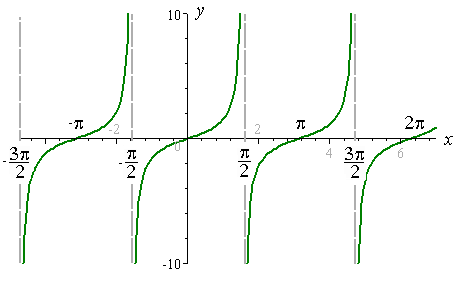
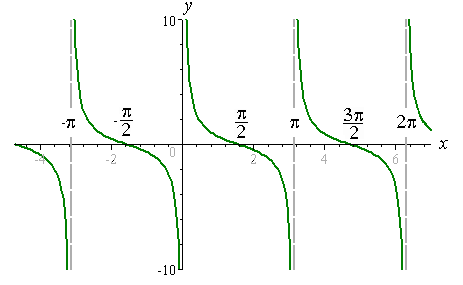
3. Why is a "normal" tangent graph uphill, but a normal cotangent graph downhill? Use unit circle ratios to explain.

Graph of tan x
This image displays a "normal" tangent graph (uphill) ^

Graph of cot x
This image displays a "normal" cotangent graph (downhill) ^

The difference between these two graphs all depend on the ASTC (quadrant signs) & the position/placement of the asymptotes. The asymptotes are placed differently b/c of their ratios. The ratio of tangent is sine/cosine therefore we must place the asymptotes on where cosine = 0. Cosine equals zero at 90 degrees (pi/2) and 270 degrees (3pi/2). For cotangent, the ratio is cosine over sine so we must place the asymptotes on where sine = 0. That would be 180 degrees (pi) and 360 degrees (2pi). We also utilize the quadrant signs. We know that for tan/cot the ASTC signs are: + - + - .  When the quadrant is positive, we graph above the x-axis. When the quadrant is negative, we graph below the x-axis. Now because the placements of the asymptotes are different for tangent & cotangent, it causes the direction of the graphs to become different.

Citations:
Images of the cot/tan graphs: http://www.intmath.com/trigonometric-graphs/4-graphs-tangent-cotangent-secant-cosecant.php

Unit T Big Question #2

2. How do the graphs of sine and cosine relate to each of the others? Emphasize asymptotes in your response. 

a. Tangent? Tan = sin/cos. When cosine is zero, it makes tangent become undefined -> thus, it will have an asymptote on the points where cos = 0: pi/2 or 3pi/2.
b. Cotangent? Cotangent is the exact reciprocal of tangent. Cotangent = cos/sine. When sine is zero, it causes cotangent to become undefined. Thus, it will have an asymptote when sine is 0 or pi.  
c. Secant? Secant is the reciprocal of cosine -> 1/cos. Thus, when cos = 0 -> it will be undefined & = asymptotes!
d. Cosecant? Cosecant is the reciprocal of sine -> 1/sin. Thus, when sine = 0 -> it will be undefined &  = asymptotes!

Sine & cosine do not have asymptotes because of their ratios. Sine = y/r. Cosine = x/r. R will always equal 1 and thus it can never be undefined.

Tan(x) graph w/ asymptotes. 
Graph of tan x
Cot(x) graph w/ asymptotes.
Graph of cot x
Csc(x) graph w/ asymptotes.
Graph y = csc x
Sec(x) graph w/ asymptotes:
Graph of sec x
Sin(x) graph: 
Graph y = sin x

Cos(x) graph: 
Graph of cos x

The images of these graphs display the placement of the asymptotes and the difference between cos/sin graphs & csc/sec/tan/cot graphs.

Citations:

Unit T Big Question #1

How do the trig graphs relate to the Unit Circle?

a. Period? - Why is the period for sine and cosine 2pi, whereas the period for tangent and cotangent is pi?

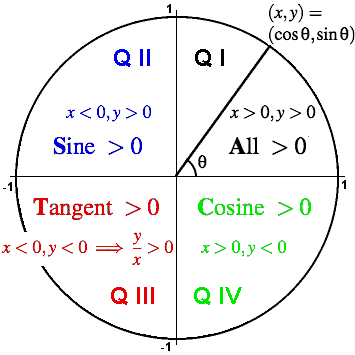
You have to consider the Unit Circle. In the Unit Circle, the quadrant signs are all different for sine, cosine, and tangent. Sine: + + - - Cosine: + - - + Tangent: + - + -

Both sine and cosine consists of a full revolution (2pi) around the unit circle. In order for you to repeat the same whole pattern of sine/cosine, you have to go the whole 360 degrees. In contrast, tangent can repeat itself right after 180 degrees (pi) because the pattern is the same for half the Unit Circle.

signs by quadrant
This image of the Unit Circle displays the quadrant signs of cosine, sine, and tangent. It displays the patterns that they all have and how it relates to the trig graphs.


b. Amplitude - How does the fact that sine and cosine have amplitudes of one (and the other trig functions don't have amplitudes) relate to what we know about the Unit Circle?

Amplitudes are half the distance between the highest and lowest points on the graph. They can be found by looking at the value of 'a.'


Sine = y/r & cosine = x/r. Remember that 'r' always equals 1, which means sine & cosine can never be  undefined because the denominator will never be zero.. instead, sine & cosine have amplitudes.

The same image above ^ also displays the highest value/distance for the amplitude from the unit circle: 1. ((0,1) (0, -1) (-1, 0) (1, 0)) You can tell that the distance from the highest/lowest points of the graph:  (0,1) and (0, -1) is actually two units but because the amplitude is HALF the distance, it is an amplitude of one.


The other trig functions (csc & sec), however, have asymptotes rather than amplitudes when sine & cosine = 0 b/c they are reciprocals of sine & cosine. Tan (sin/cos) and cot (cos/sin) also have asymptotes when their denominator = 0.

Citation: Unit Circle w/ quadrant angles 
http://mathmistakes.info/facts/TrigFacts/learn/uc/sign.html

Sunday, April 14, 2013

Assessment #4: Unit S Concept 7


What is the problem about? 
The problem is about solving equation with half angle formulas. We use the identities and input it into the equation in order to solve the problem further.

What does the viewer need to pay close attention to in order to do the problem correctly?
The viewer must pay close attention to how I utilized the identities into the equation in order to simplify it even further. Make sure when you square the problem, you have to remember to check for any extraneous solutions at the end. The viewer must pay attention to how I checked for the extraneous solutions - plugging in the degrees into the original equation and solving it to see if it worked out correctly. The viewer must remember to convert the answers into radians as well. Also remember that when dealing with these type of problems, you have to factor (by substituting 'u') in order to simplify and reach the equations that you will be working with.

Assessment #2 - Unit S Concept 4

HALF-ANGLE FORMULA


We know that the sum/difference and the half-angle formula both have the same answers by inputting our answers into a calculator. When we plug in our answers into the calculator, we reach the same result for both methods (same decimal answer).

Thursday, April 11, 2013

Student Video #1: Unit S Concept 3


What is the problem about? 
The problem is about utilizing the power reducing formulas. Using what is given, we can substitute different power reducing formulas into the problem to simplify the problem.

What does the viewer need to pay close attention to in order to do the problem correctly?
The viewer must carefully watch how I was able to substitute "m" into the equation in order to use one of the power reducing formulas and substitute "m" back into the equation after. The viewer must also watch how I foiled the problem and I was able to divide by four (by using the reciprocal) in order to simplify it even further. Be aware of how I used other power reducing formulas in order to simplify the problem.

Wednesday, March 27, 2013

Student Problem #3

What is this problem about?
This problem is about using the sum and difference formula to prove the trig of an inverse trig function.

What does the reader have to pay attention to in order to not make a mistake?
The reader must pay attention to how the the trig expression was converted to an algebraic expression. Pay close attention to how the Unit Circle values was substituted into the problem. Make sure to always use the first quadrant when you're left with ambiguity (ex: sin (0) could equal = (1, 0) or (-1, 0) but we use (1, 0) in this problem because it's part of the first quadrant.) Remember that cos = x, sin = y, and tan equals y/x :)

Tuesday, March 26, 2013

Student Problem #2


Given: cosu = -5/13 (3rd quadrant) & sinv = 15/17 (1st quadrant). Find sin(u+v) and tan(u-v).

 *on the left side I meant to put "left and down = negative" not left and right.. 


What is this problem about?
This problem is about using the sum and difference formulas when given values for right triangles. You are given two values of sin/cos/tan and plugging it into the sum and difference formulas.

What must the reader pay close attention to in order to not make a mistake?
The reader must pay close attention to drawing their triangle correctly. They must make sure it fits the quadrant. They also must make sure the signs are all correct and fits ASTC depending on which quadrant it is. They also must make sure to utilize the sum/difference formulas correctly (simplifying/multiplying fractions)..

Student Problem #1: Unit R Concept 1

285 degrees.
Difference formula

Sum formula


What is this problem about?
This problem is about finding the exact value of sums and differences using the sum and difference formulas.  We find the exact values for sine, cosine, and tangent of the angle by figuring out what angles to use by adding/subtracting to the angle we want. 

What must the reader pay close attention to in order not to make a mistake? 
The reader must pay close attention to how the sum and difference formulas are used. They should also pay cloe attention to how we are able to find the angle we want by using addition/subtraction with the degrees of the unit circle. Remember that there are many options to finding the angle we want and they all lead to the same answer.

Tuesday, March 19, 2013

Blog Post #3


Unit Q Blog Post #2


Blog Post #1


Show and explain how to derive the two remaining Pythagorean Identities from sin2x+cos2x=1. Make sure to include in the beginning where sin2x+cos2x=1 comes from to begin with (think Unit Circle!)
Pythagorean theorem : x^2 +y^2 = r^2
Sin^2x +cos^2x = 1. We know that sin = y/r & cos = x/r. Therefore, we can substitute that in -> (y/r)^2 + (x/r)^2 = 1. We also know that r = 1. If we substitute '1' for 'r' into the equation we would get -> y^2 + x^2 = 1, and since 1 = r, the equation becomes: y^2 + x^2 = r^2.

1 + tan^2x = sec^2x. Using cos^2 + sin^2 = 1, we will be able to decipher where 1 + tan^2x = sec^2x comes from. First, we divide cos^2 + sin^2 = 1 by cos^2 (x/r). 
(x/r) + (y/r) = 1 divided by (x/r). We can cancel out cos^2 (x/r) and end up with 1. Dividing (y/r) by (x/r) will give us (y/x), also known as tan^2. And dividing 1 by cos^2 will give us (r/x), also known as sec^2 - > 1 + tan^2 = sec^2.

1 + cot^2 = csc^2. Using cos^2 + sin^2 = 1, we will be able to decipher where 1 + cot^2 = csc^2 comes from. First we divide cos^2 + sin^2 = 1 by sin^2 (y/r). Dividing cos^2 (x/r) by sin^2 (y/r) will give us (x/y) which will give us cot^2. Dividing sin^2 (y/r) by  sin^2  (y/r) will give us 1. Dividing 1 by sin^2 (y/r) will give us r/y.. which is csc^2 -> 1 + cot^2 = csc^2.

Sunday, March 17, 2013

Math Analysis Reflective Blog Post

1. How have you performed on the Unit O and P tests?  What evidence do you have from your work in the unit that supports your test grade (good or bad)?  Be specific and include a minimum of three pieces of evidence.

RESPOND HERE: I performed terribly on the Unit O test the first time I took the test. I scored a 64%, I believe. It was because I barely reviewed the SSS packets mainly because I was overly confident that I knew the material from the scores of 8's of my Unit O quizzes. NEVER AGAIN! - I never want to take so much time out of my day to go to the tutoring sessions and do all of that extra work again. The second time I took the Unit O I did better because I reviewed - 91%. I performed okay on the first time I took the Unit P test - 88%. It was concept 6 (using law of sines with word problems) that really screwed me up.. My quiz scores were mainly 7's and 8's. I should have studied the SSS problems more closely and reviewed more.

2. You are able to learn material in a variety of ways in Math Analysis.  It generally follows this pattern:

→ Your initial source of information is generally the video lessons and SSS packets followed by a processing and reflection activity via the WSQ
→ individual supplemental research online or in the textbook before class
→ reviewing and accessing supplementary resources provided by Mrs. Kirch on the blog
→  discussion with classmates about key concepts
→ practice of math concepts through PQs
→ formatively assessing your progress through concept quizzes
→ cumulatively reviewing material through PTs
→ Final Assessment via Unit Test.

Talk through each of the steps given in the following terms:
a. How seriously do you take this step for your learning?  What evidence do you have to support your claim?  Make sure to make reference to all 8 steps.
b. How could you improve your focus and attention on this step to improve your mastery of the material?  What specific next steps would this entail?  Make sure to make reference to all 8 steps.

RESPOND HERE: I really do pay attention to the video lessons. In the beginning of the year, I used to not take them as seriously because I never really acknowledged how beneficial they were and how much I would struggle without watching them. I always stay focused when watching the videos and I re-watch them till I completely understand and can answer the WSQs without hesitation. I've never used the textbook or any additional supplementary resources provided by Mrs. Kirch because I never really needed to. I believe the SSS packets already helps enough. I only take the discussion with classmates about key concepts seriously if the concept is difficult for me to understand. If I need help on something, usually staying focusing during the discussions are helpful. I take the PQs pretty seriously because they help me show if I can understand how to solve each problem and understand the concept. I don't think I need to improve my focus/attention on PQs when I'm already putting enough effort into them. The concept quizzes help a lot because they show me if I understand the concept without any resources so I take them seriously as well. I guess one thing I could improve my focus and attention into the concept quizzes would be to not study the concept last minute right before the quiz because I usually forgot the material later, so I should continuously review the concept. PTs are definitely important. I always complete the PTs because they help show me if I remember the material and they also show me if I remember concepts from previous units. I can improve my focus/attention on PTs through reviewing my work for each concept before the test. The Unit Test helps display my complete understanding of ALL the concepts from the Unit. I always review the SSS packets and quizzes before the unit test to make sure I've mastered the concept.


3. Reflect on your learning this year thus far by considering the following questions:
a.  How confident do you generally feel on the day of a Unit Test?  Give evidence and specifics to back up your answer.
b.  How well do you feel you have learned the math material this year as compared to your previous years in math? Give evidence to support your claim.
c.  How DEEPLY do you feel you have learned the math material this year as compared to your previous years in math?  Give evidence to support your claim.
d.  Do you normally feel like you understand the WHY behind the math and not just the WHAT/HOW?  Meaning, do you understand why things work, how they are connected to each other, etc, and not just the procedures?  Explain your answer in detail and cite specific evidence from this year.
e. How does your work ethic relate to your performance and success?  What is the value of work ethic in real life?

RESPOND HERE: I usually feel pretty confident the day before the Unit Test. This is mainly because of all the pqs and pts that Kirch assigns to make sure I've mastered the concepts. I guess compared to my previous years in math, this year has given me the most help. With all the extra work and resources from the SSS packets, they make sure I COMPLETELY understand the material. I definitely do feel I have learned the math material because I finally understand the background of the math concepts. The math material made more sense as I was able to learn more about the derivation of the angles/triangles and how they relate the Unit Circle, and also the different types of laws (cosines/sines) and formulas.The derivation of the concepts help me understand how the concepts are connected together. At the beginning of the year.. I felt unfortunate to be forced to do all of this work and felt there was no reason behind the "flipped classroom." Now, with all the times Kirch has emphasized the real significance of the all the assigned work and how it is supposed to benefit ourselves - I felt more motivated. With this class, I've seen that all the times I've become careless, the results show. I've learned that it's more difficult to catch up with the material when you aren't on pace with the rest of the class. It's stressful and definitely not worth it :( The same goes with real life. With a strong work ethic, you will be able to become more productive and more capable of succeeding in a work environment.

Tuesday, February 12, 2013

Deriving the Unit Circle!


The special right triangle lies in Quadrant 1 of the unit circle. A 30-60-90 right triangle contains a '2n' as the hypotenuse (r), 'n' as it's opposite side (y), and n radical 3 as it's adjacent side (x). Remembering that the radius for the unit circle is always one, we have to make 'r' equalling to 1. Divide all the sides by 2 in order to make the radius one. You will end up with the lengths: 1 (hypotenuse), 1/2 (opposite side), and radical 3 over 2 (adjacent side).

When dealing with a 45-45-90 right triangle, the radius must be 1. The hypotenuse of a 45-45-90 right triangle contains n radical 2, adjacent side being n, and opposite side also being n. In order to make the radius one, divide all sides by radical 2. The hypotenuse will be 1, the adjacent side will be radical 2 over 2, and the opposite side will also be radical 2 over 2.

It matches up with the unit circle. Using the 45-45-90 right triangle, we are able to see the ordered pair matching up with the 45 degree angle -> (radical 2 over 2, radical 2 over 2). Using the 30-60-90 right triangle, we are able to see the ordered pair matching up with the 60 degree angle -> (1/2, radical 3 over 2) and the 30 degree angle -> (radical 3 over 2, 1/2).

Thursday, January 31, 2013

Conic Sections: Parabolas!

1. What is the mathematical definition of this conic section and how does that definition play a role in the properties of the conic section and how it is shaped or formed? 

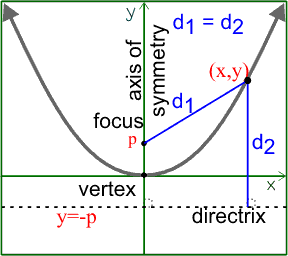
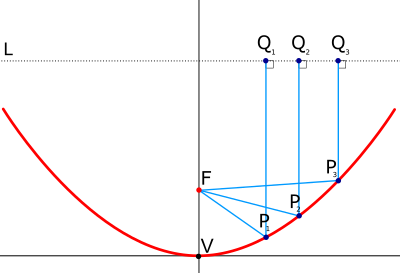
The mathematical definition of the conic section (parabola): the distance from the focus from any point on the parabola is perpendicular to the directrix. It has an equal distance between the focus and the vertex and an equal distance between the vertex and the directrix.

2. How does the focus (or foci) affect the shape of the conic section? 

P is the distance from the vertex to the focus. It affects the shape of the conic section depending on how large the # 'p' is. For example, the more smaller the # 'p' is -> the more narrow the parabola will be. The more larger the # 'p' is -> the more wider the parabola will be!

3. How do the properties of this conic section apply in real life? 

One example of how this conic section is applied in real life would be the 'whisper dish.' The whisper dish is a large plate that is able to reflect the sound waves and signals towards the other whisper dish. By talking into the focus of one dish, it may bounce off and go towards the focal point of the other whisper dish. The symmetrical shape and distance allows the whisper dish to signal and bounce off to each other.


Citations:  
Parabola image from: http://people.richland.edu/james/lecture/m116/conics/parabola.gif
Parabola (p) image from: http://upload.wikimedia.org/wikipedia/commons/thumb/2/2f/Parabola_with_focus_and_arbitrary_line.svg/400px-Parabola_with_focus_and_arbitrary_line.svg.png
Whisper dishes video from: http://www.youtube.com/watch?v=y26wYeOg_gU