Create your own Playlist on MentorMob!
Wednesday, December 12, 2012

Monday, December 10, 2012
Wednesday, November 28, 2012
Monday, November 26, 2012
Student Problem: Unit K Concept 10

What is this problem about?
This problem is about writing a repeating decimal as a rational number using geometric series.
What does the viewer need to pay attention to in order to understand the concept?
The viewer needs to pay attention to how the decimal is broken apart. For example, 56 is the repeating number so you break it apart from there. .56 Then you put it into the geometric series formula by finding a sub 1 and the ratio and you'll be able to get your rational number.
Monday, November 12, 2012
Fibonacci Haiku #3
Dogs
Loyal
Trustworthy companions
Man's best friend
Always faithful and never deceptive
Willing to love and stay by your side


Fibonacci Haiku #2
Veterans
Veterans
Heroes
Dignfied individuals
Honor and respect
Remembering those who have served
Giving gratitude for their courage, bravery, and spirit

Fibonacci Haiku #1
Books
BooksWords
Neverending pages
Open your imagination
They say knowledge is power
Enter a world that was never thought existed

Sunday, November 4, 2012
Student Problem #6: Unit J Concept 6

Student Problem #5: Unit J Concept 5

Thursday, October 18, 2012
Wednesday, October 17, 2012
Student Problem #3: Unit I Concept 1
Student Problem #3: Unit I Concept 1: (Graphing Exponential Functions)


 hopefully the image shows now?
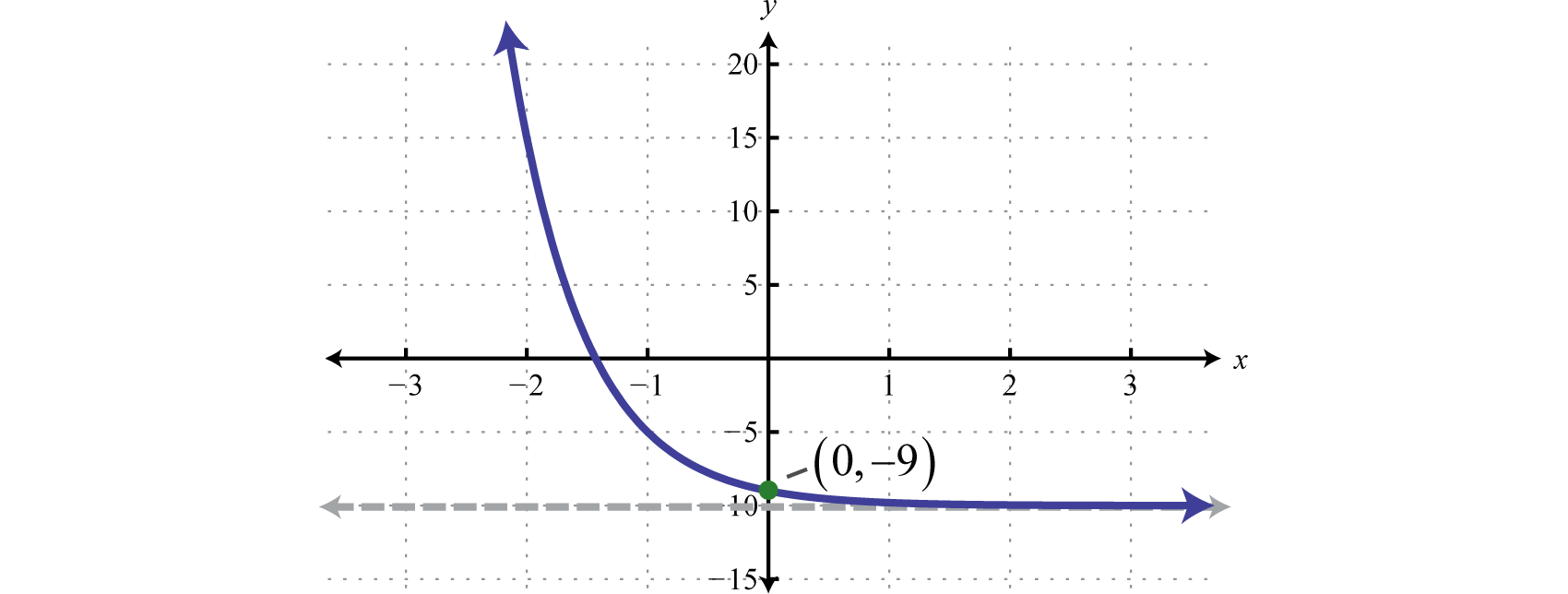
What is this problem about? This problem is about how to identify x-intercept, y-intercept, asymptote, domain, and range of an exponential function. We are also able to learn how to graph an exponential function.
What must the reader pay close attention to in order to not make a mistake? The reader must remember that a displays if the graph is above(+)/below(-) the asymptote. Remember that in this kind of function, y=k! The reader must make sure that you cannot find the x-intercept when you have you're taking the natural log of a negative number -> undefined. Also, in this kind of equation there are no x-value equations -> domain (-oo,oo) & the range depends on the asymptote. Above the asymptote: (_,oo).. below the asymptote: (-oo,_).


What must the reader pay close attention to in order to not make a mistake? The reader must remember that a displays if the graph is above(+)/below(-) the asymptote. Remember that in this kind of function, y=k! The reader must make sure that you cannot find the x-intercept when you have you're taking the natural log of a negative number -> undefined. Also, in this kind of equation there are no x-value equations -> domain (-oo,oo) & the range depends on the asymptote. Above the asymptote: (_,oo).. below the asymptote: (-oo,_).
Tuesday, October 16, 2012
Student Problem #4: Unit I Concept 2: (Graphing Logarithmic Functions)

Saturday, October 6, 2012
Friday, October 5, 2012
Student Video #1: Unit F Concept 10
Unit F: Concept 10
This video displays how to find all zeroes (real and complex) of polynomials. It shows how to solve a polynomial of the 4th degree using concepts throughout Unit F (synthetic division, p/q's, Descartes's rule of signs) *Although I wasn't speaking in the video, I helped out by outlining how to solve the equation (listing the possible zeroes (p/q's), factors, real zeroes, and how many +'s & -'s real zeroes (Descartes) there were on a whiteboard & went to take a quiz when they started solving the equation through video)..
What does the viewer need to pay attention to in order to understand the concept?
Make sure to pay attention and not create any mistakes when solving the p/q's, finding the positive/negative real zeroes (make sure the odd degrees change signs), properly using synthetic division, and finding ALL the zeroes with the rest of the polynomial.
Student Video #3: Unit H Concept 7
What is this video about? This video displays how to find logs when you're given approximations. The approximations are basically clues that you need to use and multiply/divide to equate them into the solution/treasure. You use these clues and expand them using the properties of logs (product/quotient/exponent law). Then, you substitute the values/letters that work from the clues given. What does the viewer need to pay attention to in order to understand the concept? Make sure to pay attention and not create any mistakes when factoring out the solution/treasure. Make sure to focus on attempting the clues/approximations given and see if they all work. Make sure to not forget the bonus clue from the properties of logs (base b of b = 1).
Thursday, September 27, 2012
Unit G Summary Question #10: Range is Horizonal Asymptote
10. While the domain of a rational function depends on DIVAH, what do you think the range of a rational function depends on? Give an example.
Since 'domain is vertical asymptotes and holes".. this displays they are the x-values. Domain displays the x-values. Range is the opposite of domain, so it should consist of y-values. Range of a rational function should then depend on horizontal asymptotes. For example, if the equation was f(x) = 3/x^2+x-2... to find the range, it would be the same as finding the horizontal asymptote.. since it's bigger on bottom, y=0. To find the domain, it would be the same as finding the vertical asymptote.. x= -2, x = 1.

Since 'domain is vertical asymptotes and holes".. this displays they are the x-values. Domain displays the x-values. Range is the opposite of domain, so it should consist of y-values. Range of a rational function should then depend on horizontal asymptotes. For example, if the equation was f(x) = 3/x^2+x-2... to find the range, it would be the same as finding the horizontal asymptote.. since it's bigger on bottom, y=0. To find the domain, it would be the same as finding the vertical asymptote.. x= -2, x = 1.
Unit G Summary Question #9: X-intercepts of a rational function
9. Describe how to find the x-intercepts of a rational function. Include both the long way and the shortcut way, explaining why the shortcut makes mathematical sense.

"X-intercept.. y=0!" To find the x-intercepts of a rational function, plug in zero for y. You must plug in zero for y in the simplified equation. The long way for solving the x-intercept of a rational function is by multiplying both sides by the denominator and solving it. The shortcut is to just equal the top of the rational function (numerator) equal to zero and solve. This makes sense as when you solve it the long way, the denominator is cancelled out.. which leaves you with a numerator equal to zero (the same as the shortcut way).
Unit G Summary Question #6: Hole
6. How do we find the appropriate place to plot a hole if the y-value is undefined when plugged into the original equation?
A hole appears when you can cancel any common factors off of a rational function. You use this crossed off common factor equal to zero and find the x-value. Then, plug it into the equation you simplified to gain the y-value. You should get both your x-value and your y-value (your point). This point will be plotted with an open circle.
Example of a hole:
Tuesday, September 25, 2012
Unit G Summary Question #8: Y-intercept of a rational function
8. How do you find the y-intercept of a rational function? Does this need to be done in the original or simplified equation?
Remember the chant: "y-intercept.. x=0!" To find the y-intercept, you plug in zero for all the x's in the equation. After this, solve the equation. You should end up with either one y-intercept or none. You perform this using the simplified equation.
Remember the chant: "y-intercept.. x=0!" To find the y-intercept, you plug in zero for all the x's in the equation. After this, solve the equation. You should end up with either one y-intercept or none. You perform this using the simplified equation.
Unit G Summary Question #7: Limit Notation
7. Describe how to write limit notation for vertical asymptotes and what the notation means.
To find the limit notation for vertical asymptotes, you have to factor the denominator. Set the denominator equal to 0 and solve. You should get your x and you can plug this in to the limit notation.
The limit notation for vertical asymptotes is:

If our x was 1, the limit notation would be 'As x -> 1+, f(x) -> _
As x-> 1-, f(x) -> _.' The + sign means 'from the right side' and the - sign means 'from the left side.' To complete the limit notation, plug in the simplified equation into a graphing calculator and examine the graph. Examine the direction of both the right and left side of the asymptote. If the graph is going down, then f(x) -> -oo. If the graph is going up, then f(x) -> oo. The limit notation displays what direction the graph approaches.
To find the limit notation for vertical asymptotes, you have to factor the denominator. Set the denominator equal to 0 and solve. You should get your x and you can plug this in to the limit notation.
The limit notation for vertical asymptotes is:
If our x was 1, the limit notation would be 'As x -> 1+, f(x) -> _
As x-> 1-, f(x) -> _.' The + sign means 'from the right side' and the - sign means 'from the left side.' To complete the limit notation, plug in the simplified equation into a graphing calculator and examine the graph. Examine the direction of both the right and left side of the asymptote. If the graph is going down, then f(x) -> -oo. If the graph is going up, then f(x) -> oo. The limit notation displays what direction the graph approaches.
Unit G Summary Question #5: Asymptotes
5. Describe the conditions in which a graph can cross through an asymptote.
The conditions in which a graph can cross through an asymptote depends on what kind of asymptote it is. It can be horizontal, vertical, or undefined. The graph can sometimes cross through a horizontal asymptote, but only through the middle of the graph. Graphs can sometimes cross through a slant asymptote also only through the middle of the graph. Graphs can never cross through a vertical asymptote; it would be undefined.
Example: 
Monday, September 24, 2012
Unit G Summary Question #4: Vertical Asymptote and Hole
4. What is the difference between a graph having a vertical asymptote and a graph having a hole?


A graph that has a hole is plotted with an open circle. A vertical asymptote is a vertical line. To find a vertical asymptote, you have to factor the numerator and denominator of the rational function and cross off any common factors. You set the denominator equal to zero and solve (by factoring) and you should get your equations. To find a hole, you have to set the crossed off common factors equal to zero, plug in the x-value (x) to the equation and you should get your y-value (y). This should be your point which you can use to plot (with an open circle).
Sunday, September 23, 2012
Unit G Summary Question #3: Slant Asymptote
3. When does a graph have a slant asymptote? How do you find the equation of the slant asymptote?
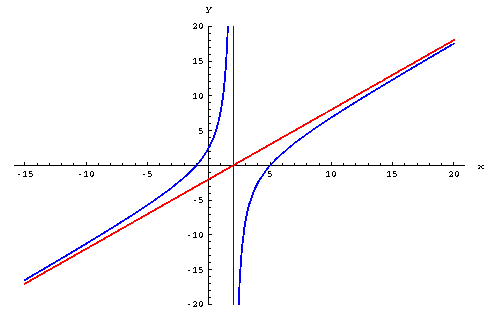
The graph has a slant asymptote when the degree of the numerator is a number higher than the degree on the denominator. To find the equation of the slant asymptote, you must use long division. Exclude the remainder, and the equation should be the equation of the slant asymptote line. The equation of the slant asymptote: y=mx+b. Remember that graphs can cross through a slant asymptote sometimes but only towards the middle of the graph.
The graph has a slant asymptote when the degree of the numerator is a number higher than the degree on the denominator. To find the equation of the slant asymptote, you must use long division. Exclude the remainder, and the equation should be the equation of the slant asymptote line. The equation of the slant asymptote: y=mx+b. Remember that graphs can cross through a slant asymptote sometimes but only towards the middle of the graph.
Unit G Summary Question #2: Limit Notation for Horizontal Asymptotes
2, Describe what limit notation for horizontal asymptotes actually means.
As x->oo, it means the graph is approaching to the right. As x->-oo, it means the graph is approaching to the left. As f(x) -> _, we're approaching a #. This is established for both x->oo, and x->-oo. We're not approaching up or down, we're approaching a number value. This makes a horizontal asymptote.
 x->-oo*
As x->oo, it means the graph is approaching to the right. As x->-oo, it means the graph is approaching to the left. As f(x) -> _, we're approaching a #. This is established for both x->oo, and x->-oo. We're not approaching up or down, we're approaching a number value. This makes a horizontal asymptote.
Unit G Summary Question #1: Horizontal Asymptote
1. How do we know if a graph has a horizontal asymptote? What are the three options?
We can tell if a graph has a horizontal asymptote by comparing the degrees of the numerator and the denominator. If the bottom has the bigger degree, the asymptote is y=0. If they're both the same degree, the asymptote is the ratio of the coefficients. If the degree is bigger on top, there is no horizontal asymptote. Remember that graphs can only sometimes cross through a horizontal asymptote but only through the middle of the graph.

We can tell if a graph has a horizontal asymptote by comparing the degrees of the numerator and the denominator. If the bottom has the bigger degree, the asymptote is y=0. If they're both the same degree, the asymptote is the ratio of the coefficients. If the degree is bigger on top, there is no horizontal asymptote. Remember that graphs can only sometimes cross through a horizontal asymptote but only through the middle of the graph.
Subscribe to:
Posts (Atom)