How do the trig graphs relate to the Unit Circle?
a. Period? - Why is the period for sine and cosine 2pi, whereas the period for tangent and cotangent is pi?
You have to consider the Unit Circle. In the Unit Circle, the quadrant signs are all different for sine, cosine, and tangent. Sine: + + - - Cosine: + - - + Tangent: + - + -Both sine and cosine consists of a full revolution (2pi) around the unit circle. In order for you to repeat the same whole pattern of sine/cosine, you have to go the whole 360 degrees. In contrast, tangent can repeat itself right after 180 degrees (pi) because the pattern is the same for half the Unit Circle.
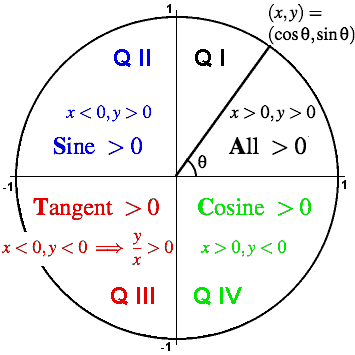
This image of the Unit Circle displays the quadrant signs of cosine, sine, and tangent. It displays the patterns that they all have and how it relates to the trig graphs.
b. Amplitude - How does the fact that sine and cosine have amplitudes of one (and the other trig functions don't have amplitudes) relate to what we know about the Unit Circle?
Amplitudes are half the distance between the highest and lowest points on the graph. They can be found by looking at the value of 'a.'
Sine = y/r & cosine = x/r. Remember that 'r' always equals 1, which means sine & cosine can never be undefined because the denominator will never be zero.. instead, sine & cosine have amplitudes.
The same image above ^ also displays the highest value/distance for the amplitude from the unit circle: 1. ((0,1) (0, -1) (-1, 0) (1, 0)) You can tell that the distance from the highest/lowest points of the graph: (0,1) and (0, -1) is actually two units but because the amplitude is HALF the distance, it is an amplitude of one.
The other trig functions (csc & sec), however, have asymptotes rather than amplitudes when sine & cosine = 0 b/c they are reciprocals of sine & cosine. Tan (sin/cos) and cot (cos/sin) also have asymptotes when their denominator = 0.
Sine = y/r & cosine = x/r. Remember that 'r' always equals 1, which means sine & cosine can never be undefined because the denominator will never be zero.. instead, sine & cosine have amplitudes.
The same image above ^ also displays the highest value/distance for the amplitude from the unit circle: 1. ((0,1) (0, -1) (-1, 0) (1, 0)) You can tell that the distance from the highest/lowest points of the graph: (0,1) and (0, -1) is actually two units but because the amplitude is HALF the distance, it is an amplitude of one.
The other trig functions (csc & sec), however, have asymptotes rather than amplitudes when sine & cosine = 0 b/c they are reciprocals of sine & cosine. Tan (sin/cos) and cot (cos/sin) also have asymptotes when their denominator = 0.
Citation: Unit Circle w/ quadrant angles
http://mathmistakes.info/facts/TrigFacts/learn/uc/sign.html
No comments:
Post a Comment